
Emerald ash borer (EAB) is the most destructive forest pest in North American history, and it started right here. The insect was first identified in Canton Township in 2002, about 40 minutes south of Waterford, and within twenty years it had killed an estimated tens of millions of ash trees across Michigan and spread to most of the eastern United States. Oakland County took a particularly hard hit. Ash was one of the most commonly planted street and landscape trees in suburban Detroit during the post-war build-out, and the loss was both economically and visually massive.
By now, in 2026, the front of the EAB wave moved through Oakland County more than a decade ago. Most of the unprotected ash trees in Waterford, West Bloomfield, Commerce Township, and the surrounding communities are already dead. But “most” isn’t all, and the dead trees are still everywhere. This article covers what’s actually going on with EAB in Oakland County right now, how to identify ash trees on your property, what your options are for the ones still standing, and why standing dead ash needs to come down sooner rather than later.
A Quick Background on EAB
Emerald ash borer is a small green beetle native to East Asia. It probably arrived in southeast Michigan in shipping pallets sometime in the 1990s and went undetected for about a decade before being identified. The beetle itself doesn’t directly kill trees. The damage comes from the larvae, which tunnel under the bark and feed on the cambium — the layer that transports water and nutrients between the roots and the canopy. Once enough larvae have tunneled through the cambium, the tree essentially starves.
What made EAB so devastating in North America is that our native ash species (white ash, green ash, black ash, blue ash, and pumpkin ash) have no evolved resistance to it. In Asia, native ash species and EAB co-evolved, and the trees have defenses that limit the damage. Here, ash trees are basically defenseless. Once a tree is infested, it typically dies within 2 to 5 years without treatment.
The Michigan Department of Agriculture and Rural Development, along with the Michigan Invasive Species Program, maintains current information on EAB distribution, treatment options, and reporting. Most of Lower Michigan is now considered fully infested.
How to Identify an Ash Tree on Your Property
Before you can deal with EAB, you have to know whether you actually have an ash tree. A lot of homeowners don’t, and ash gets confused with several other species. Here’s how to tell:
Compound leaves with 5 to 9 leaflets. Ash trees have compound leaves, meaning each “leaf” is actually a stem with multiple leaflets attached. The leaflets are usually oval to lance-shaped, with smooth or slightly serrated edges.
Opposite branching. Branches on an ash tree come off the trunk and larger limbs directly across from each other — opposite rather than alternating. This is one of the most reliable identifiers. Most other trees you’d commonly find in Oakland County have alternate branching.
Diamond-pattern bark on mature trees. White ash and green ash develop a distinctive bark pattern with raised, diamond-shaped ridges separated by deeper grooves. On younger trees the bark is smoother, but the diamond pattern develops as the tree matures.
Single seed wings. Ash seeds are long, narrow, single-winged samaras – sort of like maple “helicopters” but with just one wing and a longer, narrower shape. They hang in clusters on the female trees in fall and winter.
If you’re not sure whether you have ash, several things help. Check whether the branches are opposite. Look up the leaf shape on a reference site or app. The Michigan DNR and MSU Extension both have detailed identification guides online.
If you have ash trees in Oakland County and they haven’t been treated, the realistic assumption is that they’re either already dead, currently dying, or about to start.
Signs Your Ash Tree Has EAB
EAB symptoms develop in a predictable progression, though by the time most of them are obvious, the tree is already significantly compromised.
Canopy thinning at the top of the tree. EAB infestations usually start in the upper canopy, and the first visible symptom is often a thinning crown. The top of the tree starts looking sparse, sometimes with smaller-than-normal leaves, while the lower branches still look normal.
Dieback of branches. Individual branches start dying off, again typically starting in the upper canopy and working downward over a year or two.
Epicormic sprouting. As the upper canopy dies, the tree often produces vigorous shoots low on the trunk or from the roots — the tree’s last-ditch attempt to survive by growing new leaf area from undamaged tissue. Dense clusters of sprouts at the base of an otherwise declining ash is a strong EAB indicator.
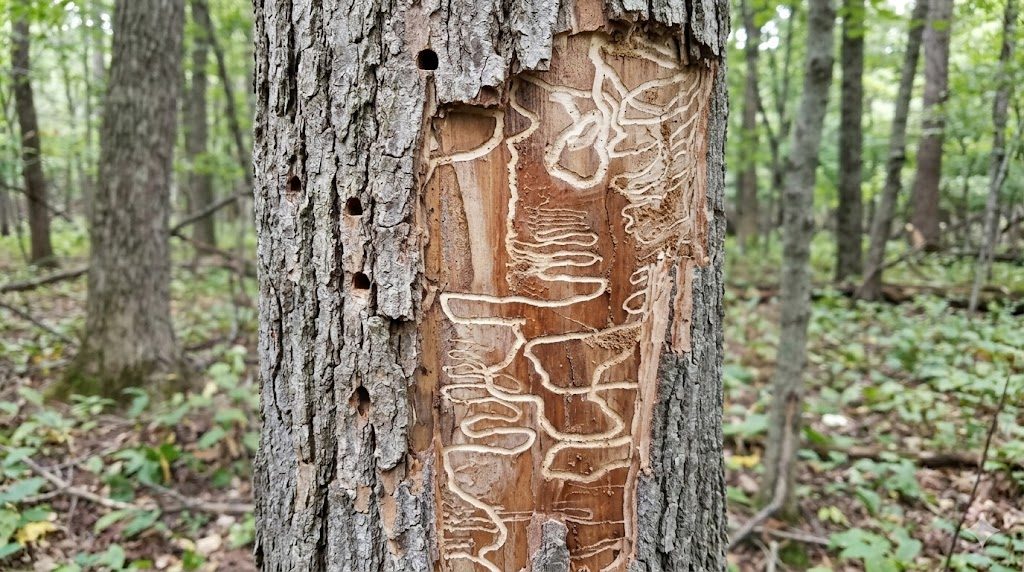
S-shaped galleries under the bark. If you peel back a patch of loose bark on an infested or recently killed ash, you’ll see distinctive S-shaped or serpentine tunnels in the wood underneath. These are the larval galleries, and they’re EAB’s signature.
D-shaped exit holes. Adult EAB beetles emerge from infested trees through small (about 1/8 inch) D-shaped exit holes in the bark. You usually need to look closely to find them, but once you know what to look for, they’re distinctive.
Increased woodpecker activity. Woodpeckers feed on EAB larvae, and heavy woodpecker damage on an ash tree — large patches of bark removed, exposing the lighter sapwood underneath — is often called “blonding.” It’s a strong indicator that the tree is heavily infested.
Splitting bark. Vertical splits in the bark, often revealing the S-shaped galleries underneath, develop in advanced infestations.
Should You Treat or Remove?
For an ash tree showing EAB symptoms, the practical options come down to treatment or removal. The decision depends on how advanced the infestation is, how valuable the tree is to your property, and how much you’re willing to spend on ongoing maintenance.
Treatment for EAB typically involves systemic insecticide injections, usually with a chemical called emamectin benzoate (brand name TREE-äge or similar products). These injections are done by certified applicators every 2 to 3 years and have been shown to be highly effective at preventing or controlling EAB infestations when the tree is still relatively healthy.
The catch: treatment works best as a preventive measure or on lightly infested trees. Once an ash has lost more than about 30 to 50 percent of its canopy to EAB damage, treatment becomes much less effective and the tree probably can’t be saved. Treatment is also an ongoing commitment — every 2 to 3 years, indefinitely, as long as you want the tree to survive.
Removal is the right call for trees that are too far gone for treatment to work, for property owners who don’t want the ongoing maintenance commitment, or for trees in locations where the risk of failure outweighs the value of keeping them around. For a healthy mature ash on a high-value property with sentimental value, treatment may make sense. For a declining ash overhanging your roof, removal is the answer.
Why Standing Dead Ash Is Dangerous
The biggest issue we deal with in Oakland County right now isn’t actively infested ash trees — it’s the standing dead ones. EAB-killed ash dries out and brittles up faster than almost any other species. Within 2 to 3 years of death, the wood loses its structural integrity to a degree that makes the tree extremely unpredictable.
What this looks like in practice:
- Branches snap off without warning. Dead ash limbs come down in light wind, sometimes with no wind at all.
- Bark sloughs off in sheets. The bark detaches from the dead wood, often falling in large pieces that can hit anything below.
- Trunks can fail unexpectedly. As decay progresses, dead ash can fail at the trunk in conditions that wouldn’t damage a sound tree.
- Removal becomes more dangerous and more expensive. Climbing a dead ash to take it down is significantly more risky than climbing a sound tree, and crews often have to bring in a crane for trees that could have been climbed conventionally a year or two earlier.
This is why every credible arborist in Oakland County is going to push you toward removing dead ash sooner rather than later. The longer it stands, the more dangerous and more expensive the removal becomes. And there’s no upside to leaving it — the tree isn’t coming back, the wood isn’t getting more valuable, and every storm season increases the risk of it falling on its own and taking part of your property with it.
Replanting After EAB Removal
The good news about removing a dead ash is that you’ve got a great opportunity to replant with something more resistant. Some species that work well in Oakland County and aren’t on any active major pest watch lists:
- Bur oak (Quercus macrocarpa) — extremely durable, native, handles Michigan winters and lake-effect weather well.
- White oak (Quercus alba) — slower growing but exceptionally long-lived, good shade tree.
- Swamp white oak (Quercus bicolor) — handles wet soils well, good for properties with drainage issues.
- Hackberry (Celtis occidentalis) — native, durable, often overlooked, performs well in urban conditions.
- American linden (Tilia americana) — also called basswood, provides dense shade and supports pollinators.
- Kentucky coffeetree (Gymnocladus dioicus) — native, drought-tolerant, very pest-resistant.
- Tuliptree (Liriodendron tulipifera) — fast-growing, tall, classic Eastern hardwood.
What you want to avoid: planting another ash, planting too many of any single species (diversity protects you against the next pest), or planting trees that have known issues with the specific conditions on your site. A good arborist or local nursery can help you match the species to the location.
A Note on Spotted Lanternfly
While we’re talking about invasive species: spotted lanternfly has been confirmed in Michigan and is starting to show up in Oakland County. It feeds on a wide range of host plants and can stress and damage trees, though it’s generally not as immediately lethal as EAB is to ash. The Michigan Invasive Species Program asks residents to report sightings, and homeowners with trees of any kind should learn to identify it. Both the Michigan Invasive Species Program and Michigan State University Extension have current ID guides and reporting tools.
What to Do If You Have Ash Trees in Waterford or West Bloomfield
If you’ve got ash trees on your property and you’re not sure what condition they’re in:
- Get them identified and assessed. If you’re not certain they’re ash, or you’re not sure whether they’re infested or already dead, have someone look at them.
- Decide on treatment or removal. For healthy trees still worth saving, talk to a certified applicator about systemic treatment. For trees with significant canopy loss or signs of advanced infestation, plan for removal.
- Don’t wait on dead ash. Standing dead ash gets more dangerous and more expensive to remove every year. Schedule removal before the wood gets too brittle to climb safely.
- Replant when possible. Replacing the canopy with a more resistant species protects the next generation of your property’s tree cover.
Otto Tree Service handles ash removal across Waterford, West Bloomfield, Commerce Township, Walled Lake, White Lake, and the surrounding Oakland County communities. We do ash removal almost every week — it’s one of the most common calls we get, and we have the equipment (including crane-assisted removal) for the trees that have gotten too brittle for conventional takedown.
Free on-site evaluations, transparent pricing, no cash up front on insurance work, and total cleanup on every job.
Call (248) 617-8644 to schedule.
