
Key Takeaways
- Sudden leaf changes or bare branches at the top of an Oak or Maple are often the first signs of deep-rooted health issues.
- Mushrooms at the base of your tree are not just a nuisance; they usually mean the roots are rotting underground.
- Maples are prone to trunk splitting due to temperature swings, which can lead to total tree failure if ignored.
- A leaning tree combined with cracked or heaving soil is a major safety hazard that needs immediate attention.
- Catching these symptoms early can save you thousands in property damage and might even save the tree itself.
Oaks and Maples are the true anchors of any good yard. They provide that deep summer shade we all love, and they make our neighborhoods look established and welcoming. But because these trees are so big and seem so permanent, it is easy to forget that they can get sick or structurally weak just like anything else. We often see homeowners wait until a giant limb is lying on their roof before they realize something was wrong. In our part of the country, these trees take a beating year-round. From heavy snow loads that pull on branches to summer storms with high winds, the stress adds up.
If you have a large Oak or Maple near your house or driveway, you need to know what to look for. A healthy-looking tree can sometimes be a shell of itself on the inside, and by the time it looks dead to the naked eye, it might already be a falling hazard. Trees do not usually die overnight; they give us signs and signals that something is wrong. The trick is knowing how to read them before the next big storm rolls through.
1. The Top-Down Fade (Crown Dieback)
If you look up at your tree and notice that the very top branches are bare while the rest of the tree is full and green, you have a problem. This is called crown dieback, and it is basically the tree’s way of saying it can’t get enough fuel to its furthest extremities. Imagine a water pump trying to push water to the tenth floor of a building; if the pump is weak the top floor stays dry.
For a Maple, this often happens because the soil is too packed down for the roots to breathe or because the roots are actually wrapping around the trunk and choking it (girdling roots). Maples are very sensitive to changes in soil grade and compaction. For an Oak, this is a lot scarier because it’s one of the first things we see with certain fungal diseases that can wipe out a tree in no time. If the top of your tree looks like a bunch of gray skeleton fingers reaching for the sky, it is time to act. Those dead branches are brittle and will eventually snap, falling from a great height with enough force to pierce a roof or a car hood.
2. Deep Trunk Cracks and Bark Sores
Trees are pretty good at healing themselves from small nicks, but deep vertical cracks are a different story. Maples have relatively thin skin compared to other trees, and they often get what we call frost cracks. The sun warms the bark during the day, and then the temperature plunges at night, causing the wood to pop and split. While a small crack might close up a deep one that goes way into the wood is an open door for rot and bugs.
If you see a crack that looks like a deep seam or a canker (which looks like a sunken, weeping sore on the bark), it means the tree is struggling to hold its own weight. Cankers are localized areas of dead bark and underlying wood caused by bacteria or fungi. They essentially girdle the branch or trunk, cutting off the flow of nutrients. If that crack or canker is right where a big branch meets the trunk, that limb is a prime candidate to snap. We often see these wounds become nesting grounds for carpenter ants or wood borers, which only accelerate the internal decay.
3. Mushrooms Growing at the Base
A lot of people think mushrooms in the yard are just a sign of a wet season, but if they are growing right up against the trunk or on the roots of your oak or maple, it is a bad sign. Mushrooms are the fruit of a fungus that eats decaying wood. If they are at the base, it means the wood inside the roots or the lower trunk is rotting away. This is a process that can take years, but once the mushrooms appear, it means the decay is advanced.
This is what we call invisible instability. The tree might look perfectly fine and have a full head of green leaves, but underground, its anchors are turning to mush. A tree with root rot is like a tall ladder standing on soft mud, eventually it is going to tip. There are specific types of fungi to watch for, like Ganoderma, which creates hard, shelf-like structures on the bark. If you see these, do not ignore them. The structural integrity of the tree is being eaten from the inside out, and the root system may no longer be strong enough to hold the tree upright in high winds.
4. The New Lean and Ground Heaving
Trees don’t always grow perfectly straight. Most have a little tilt as they reach for the sun. But if your tree suddenly looks more crooked than it did last month, you need to pay attention immediately. A tree that develops a sudden lean is a tree that is failing. Look at the ground on the opposite side of the lean. If the dirt is mounded up, cracked, or looks like it is being lifted, it means the root ball is literally pulling out of the earth.
Maples have shallow roots, so they are notorious for this after a long period of rain when the ground gets soft, and the wind picks up. An Oak is much heavier, so if it starts to move, it is carrying a massive amount of momentum. This is a critical safety hazard. Ground heaving is the ultimate sign that the anchor has failed. If you see heaving soil around the base of a leaning tree, do not park your car under it and definitely do not let the kids play nearby. This is the stage where the tree could fall at any second, even without a strong wind, because gravity is doing all the work.
5. Early Fall Colors (The Distress Signal)
We all love it when the Maples turn bright red, but if it is happening in the middle of August, your tree is in trouble. When a tree starts changing color or dropping leaves months before it should, it is basically in panic mode. This is called early senescence. It is trying to save energy because it is being attacked by a disease, a pest, or severe environmental stress.
We see this a lot with Maples that have tar spots or Oaks that are being hit by borers or vascular wilts. If your tree looks like it is ready for Halloween while everyone else is still in summer mode, it is a clear sign of stress. In some cases, the tree is simply thirsty, but in many cases, it is a sign that the root system can no longer support the canopy. Catching the problem while the tree is still colorful (but alive) gives us a much better chance of treating it. If you wait until the tree is completely brown and brittle, the chances of saving it drop to almost zero. When your Oaks or Maples start showing these red flags, you shouldn’t wait around to see what happens. A falling tree doesn’t just damage property; it puts your family at risk.
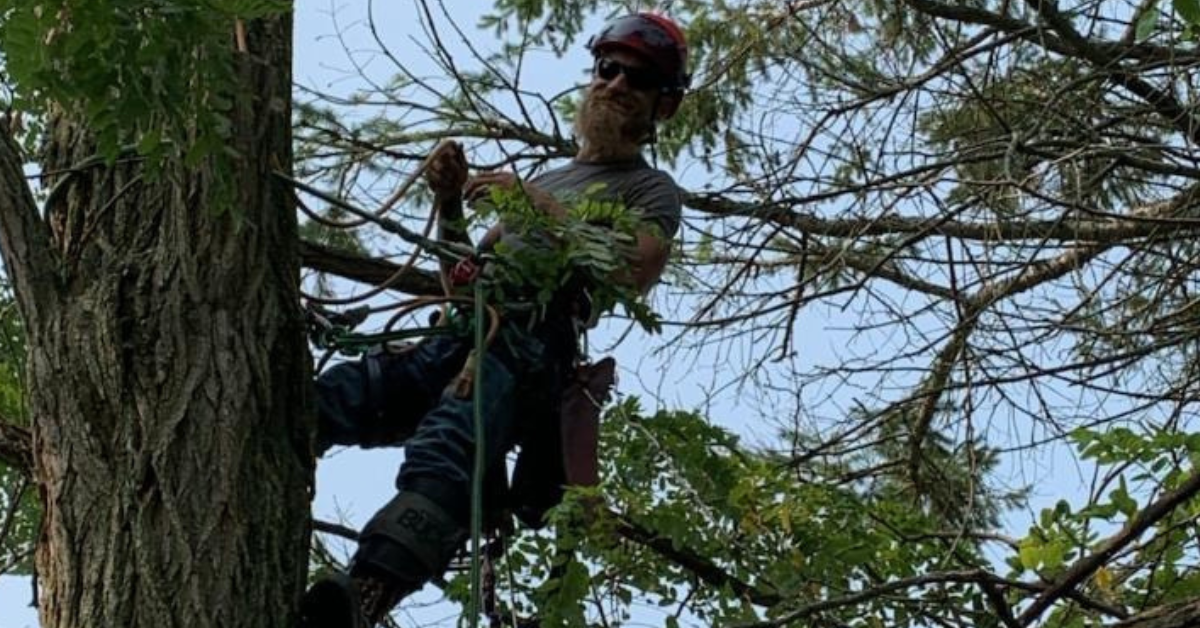
Since 2017, Otto Tree Service has provided professional tree services backed by 22 years of combined experience, a 5-star rating, and BBB A+ accreditation. As a locally owned and family-operated, licensed and insured company, we deliver expert tree care, including tree trimming and pruning, emergency tree removal, storm repair, stump grinding, and land and lot clearing. Our team uses specialized equipment and offers competitive pricing, a workmanship and no-surprise guarantee, free estimates, and 24/7 emergency tree services. With 1,000s of satisfied clients, we treat every property with care, provide fast, reliable service, and use eco-friendly practices and sustainable techniques to keep your landscape safe and healthy.
Storm damage or sudden hazards? We are ready to respond at any time, day or night. Our 24/7 emergency service ensures your property stays safe when it matters most. Your satisfaction drives everything we do. We are focused on delivering results that leave your property looking stunning and you feeling confident about your investment with our satisfaction guaranteed promise.
